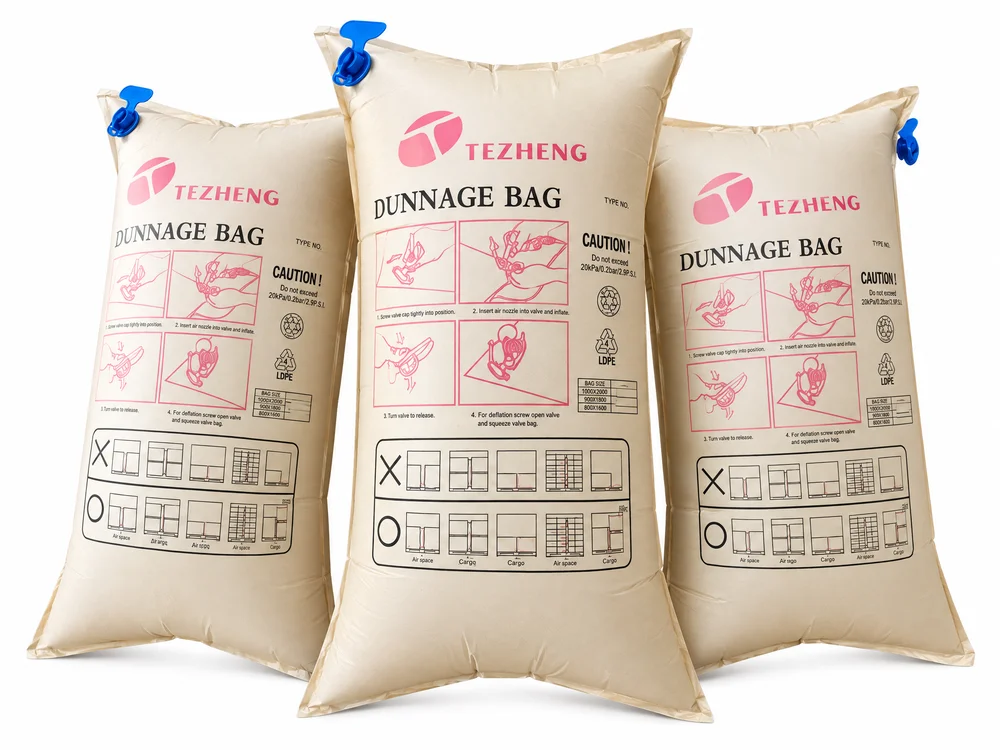
Dunnage Air Bag
Dunnage air bags fill the voids between cargo inside containers and truck trailers. Place the uninflated bag into the gap and inflate — it expands in seconds into firm bracing that stops cargo from shifting, toppling or colliding during braking, cornering and bumps. One of the most cost-effective container securing methods in international logistics today.
- Three series covering every loading scenario
- Inflates in seconds — fast and effortless
- Folds flat for minimal warehouse space
- Kraft paper version is recyclable
- Sizes and materials customizable
- Exported to 10+ countries and regions
Tezheng dunnage air bags fill 10–50 cm voids between cargo in containers and trucks, bracing loads against shifting and toppling. Three series — kraft paper composite, PP woven fabric, large valve — in 6 standard sizes (50×100 to 120×180 cm). Max inflation pressure 0.3 bar; inflates in seconds with a standard air compressor. Exported to 10+ countries. Custom sizes and materials available. MOQ 5,000 pcs; lead time approx. 20 days from production to arrival at port. SGS-tested — passes US TPCH packaging toxics legislation for chemical safety (heavy metals, phthalates, PFAS); report GZHL250803379101SD (Aug 2025).
Specifications
| Series | Outer Material | Inner Bag | Standard Sizes (W×H cm) | Void Range |
|---|---|---|---|---|
| Kraft Paper Composite | Kraft paper + PP laminate | PE/PA co-extruded film | 50×100 / 80×120 / 90×180 / 100×180 / 100×220 / 120×180 | 10–45 cm |
| PP Woven Fabric | PP woven fabric | PE/PA co-extruded film | 50×100 / 80×120 / 90×180 / 100×180 / 100×220 / 120×180 | 10–50 cm |
| Large Valve | Kraft paper + PP laminate | PE/PA co-extruded film | 50×100 / 80×120 / 90×180 / 100×180 / 100×220 / 120×180 | 10–45 cm |
Standard sizes above; width, height and material weight can be customized to your container and cargo. Recommended inflation pressure: max 0.3 bar. Contact us for sizing advice.
Download the Dunnage Bag Selection & Inflation Guide (PDF) — free from our Resources page; just leave your work email.
Features
Inflates in Seconds
A standard air compressor with an inflation gun fills a bag in seconds — far faster than timber bracing or carton fillers.
Reliable Strength
Multi-layer composite construction with heat-sealed edges holds firm under the bumps of long ocean voyages.
Moisture & Dust Proof
The PP woven series resists moisture, abrasion and punctures — ideal for humid ocean shipping conditions.
Eco-Friendly
The kraft paper series is recyclable. Bags fold flat, saving warehouse and freight space.
Easy to Use
No training needed. The large-valve version inflates even faster and seals automatically without leaking.
Lower Total Cost
Compared with timber dunnage: lower purchase, storage and labor costs — and reusable across shipments.
Applications
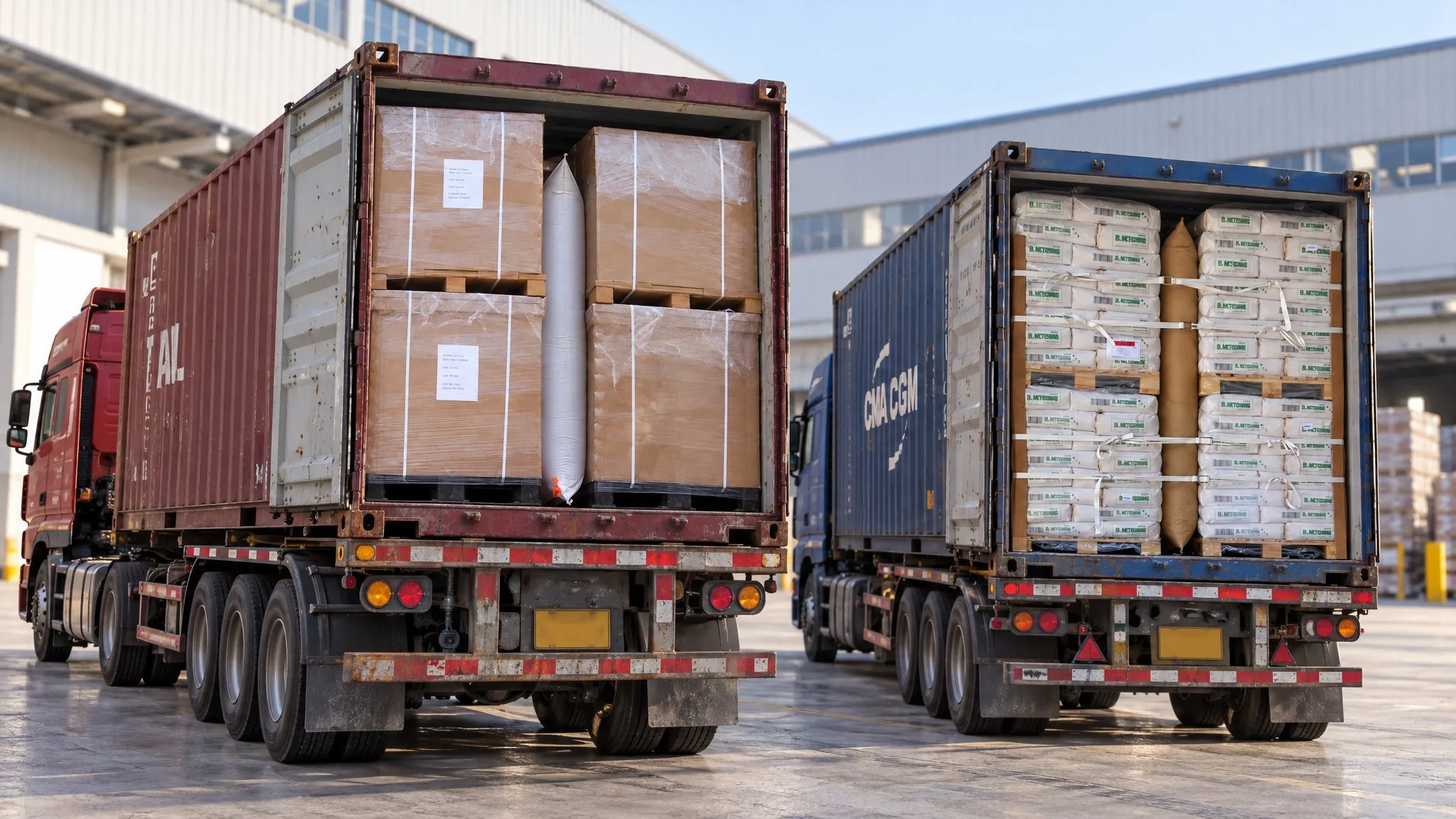
Anywhere voids exist between cargo and container walls, dunnage bags secure the load:
Especially effective for cartons, palletized goods, drums and bagged cargo — and ideal for mixed, multi-consignee container loads where flexibility matters.
How to Use
Measure the void, choose the size
Measure the gap between cargo units or between cargo and the container wall, and choose a bag slightly narrower than the gap.
Place and unfold the bag
Slide the uninflated bag flat into the void with the valve facing outward. Make sure it is fully unfolded.
Inflate to brace
Apply the inflation gun to the valve — the bag fills in seconds, expanding to press firmly against cargo and walls.
Remove gun, seal, done
Once properly filled, remove the gun. The valve seals automatically. Check for leaks, then close and ship.
First-time customers receive free remote guidance to train your loading team.
How It Compares
| Tezheng Dunnage Air Bag | Timber Bracing | Loose Fillers | |
|---|---|---|---|
| Installation time | Seconds with air compressor | 15–30 min of carpentry | Manual filling, uneven |
| Storage when unused | Folds flat, minimal space | Bulky timber stock | Bags of filler take space |
| Moisture resistance | PP woven series resists moisture | Wood absorbs moisture | Varies |
| Recyclable option | Kraft paper series recyclable | Biodegradable | Often plastic-based |
Frequently Asked Questions
Related guides: Dunnage Bag Sizes Guide · Dunnage Bag Pressure Guide · Kraft vs PP Woven · Container Securing Solution
Not sure which size you need?
Tell us your container type and cargo dimensions — we will recommend the right bag size and quantity, free of charge
Contact Us WhatsApp Us