In short: yes, dunnage bags lose pressure slowly over time — but a sound bag should stay firm for a normal ocean voyage lasting several weeks. The slow loss comes from tiny amounts of air seeping past the valve and seams, plus pressure falling as the air inside cools. A bag that goes soft within hours, or flat overnight, is not deflating normally: it has a leak, a puncture, or it was fitted into a void wider than its rated range.
Every air-filled bag leaks a little. The question shippers actually care about is not whether pressure falls, but whether it falls fast enough to matter before the container is unloaded. A well-made dunnage bag, inflated correctly and protected from sharp edges, holds its brace for the whole journey. The sections below explain how long that is, what speeds the loss up, and how to check and top up a bag before it becomes a problem.
How long do dunnage bags hold air?
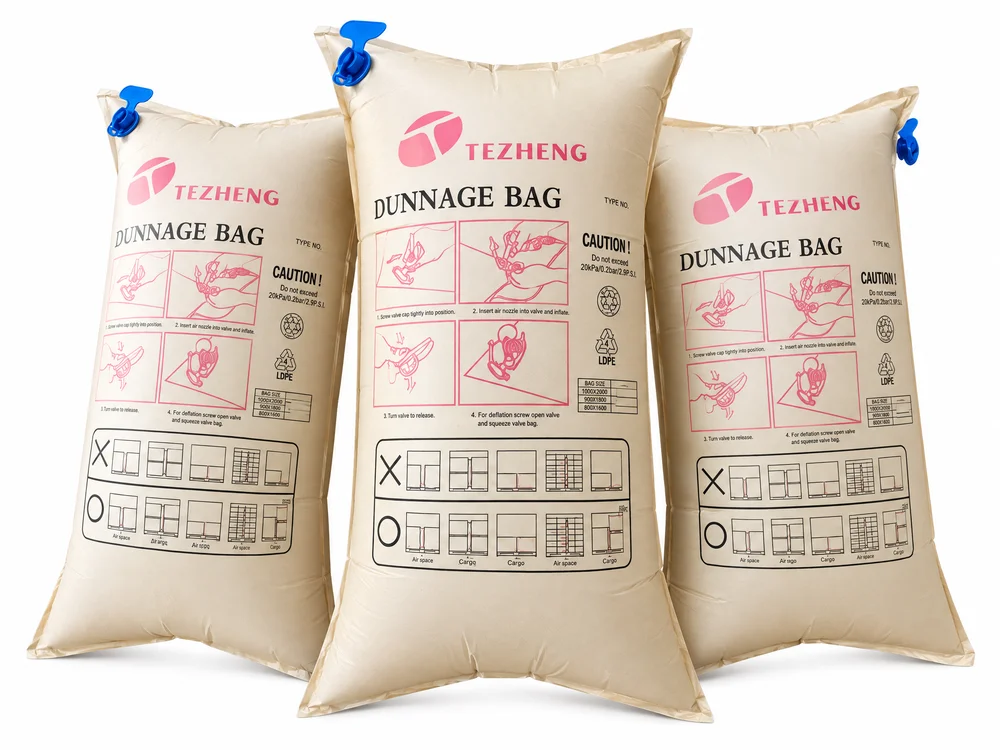
A good-quality dunnage bag with a PA/PE co-extruded inner film — the construction Tezheng uses — is designed to hold working pressure across a typical ocean voyage of several weeks. The inner film is the air barrier; the outer kraft paper or PP woven layer protects it and carries the load. As long as the valve seals properly and the bag is undamaged, the pressure loss over a voyage is small enough that the bag still braces the cargo firmly at destination. Kraft paper composite bags can even be reused 2 to 4 times when they come back undamaged, which would be impossible if they bled air quickly.
That said, "holds air for weeks" assumes the bag was inflated to its rated working pressure in the first place — never above 0.3 bar — and fitted into a void within its rated range (Tezheng bags cover voids of 10 to 45 cm, or 10 to 50 cm in the PP woven series). A bag stretched across too wide a gap, or inflated far below its working pressure, starts the voyage already soft and only gets softer. For the full sizing method, see what size dunnage bag do I need and our inflation pressure guide.
Key figures at a glance
- Maximum working pressure: 0.3 bar — never inflate above this; Tezheng dunnage bag guidance, current as of November 2026.
- Void range: 10 to 45 cm across six sizes; 10 to 50 cm in the PP woven series — Tezheng product range, current as of November 2026.
- Temperature effect: pressure changes by roughly 0.3% per 1 °C near room temperature at constant volume — ideal gas law, general physics; a 10 °C drop therefore costs about 3% of pressure with no leak at all.
- Reuse: kraft paper composite bags 2 to 4 times when undamaged — Tezheng reuse guidance, current as of November 2026.
What makes a dunnage bag lose pressure?
Temperature change. This is the most misunderstood cause. Air inside a sealed bag follows the temperature around it: when the container cools — a night sailing, a cold port, a refrigerated hold nearby — the air contracts and the pressure falls, even though no air has escaped. Around room temperature the change is roughly 0.3% of pressure per 1 °C, so a 10 °C drop costs about 3%. The bag feels a little softer, but nothing is broken. When the temperature rises again, some of that pressure returns. Inflate bags at the loading temperature and allow for the route's coldest leg, rather than judging a bag by how it feels on a cold morning alone.
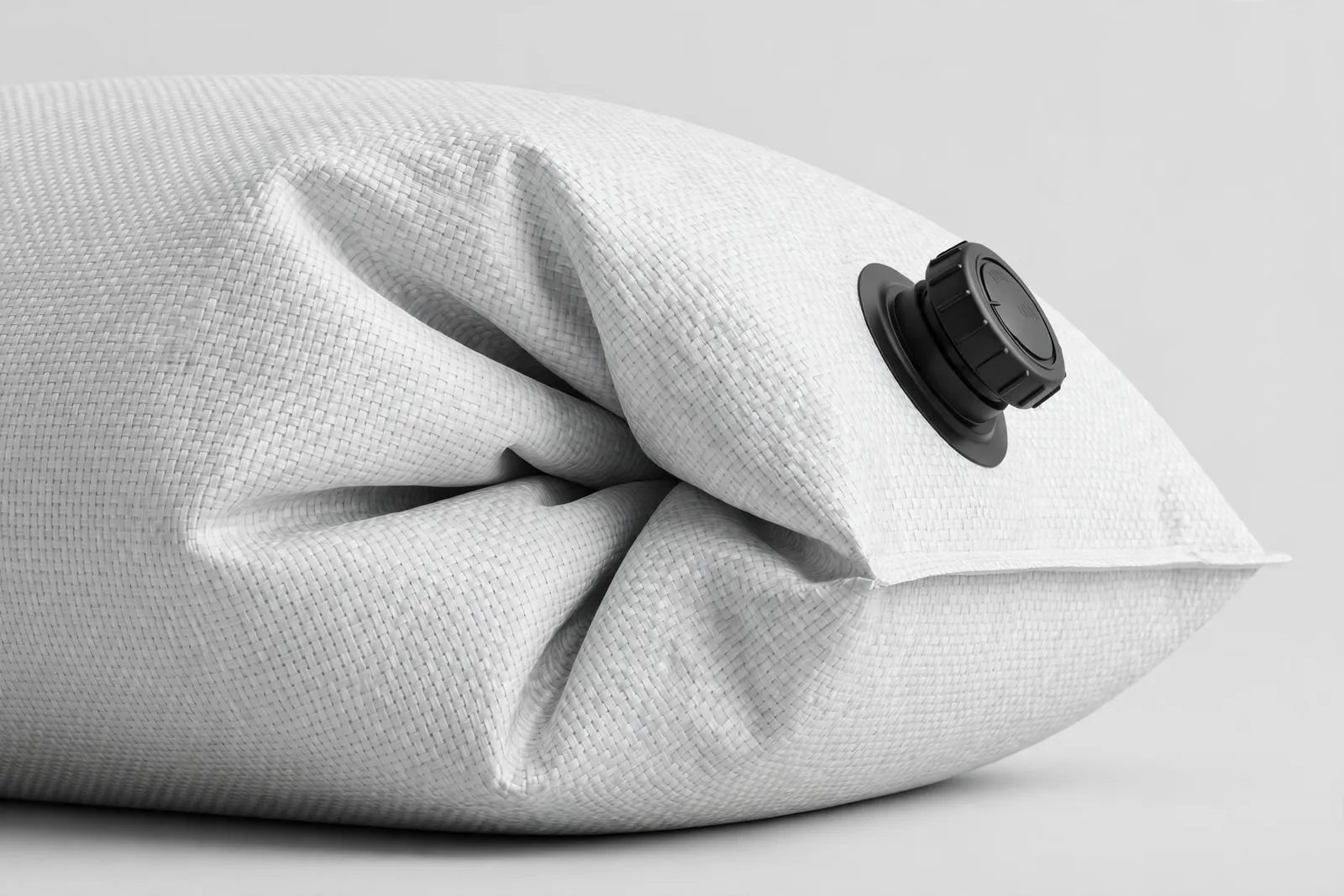
Valve seepage. The inflation valve is the one moving part. A valve that did not lock fully after the gun was removed, or one with dust or grit in the seal, lets air escape slowly — the classic slow leak. Always confirm the valve clicks or locks shut after inflating, and keep valves clean and dry before use.
Punctures and abrasion. Exposed pallet nail heads, splintered deck boards, sharp carton corners and protruding strap buckles can pierce the outer layer and the inner film. A small puncture may not be obvious at loading — the bag looks fine, then softens over the first day. Cover sharp points with cardboard before the bag goes in; it is the cheapest insurance in container loading. For the full checklist, see how to use a dunnage bag in a container.
Cargo settling and compression. Cartons settle under vibration and their own weight during transit, and the load can press the bag into a slightly different shape. The bag is not losing air — the void is changing shape around it — but the result feels the same: less brace. Tight, well-unitised loads settle less, which is another reason to strap cartons together before bracing the gaps.
Over-wide voids and over-inflation. A bag forced to span a gap wider than its rated range is stretched thin, and stretched film leaks and bursts more easily. Likewise, pumping past 0.3 bar to "make up for" a soft bag stresses the seams and the valve and can create the very leak you were trying to avoid. The fix for a soft load is the right size of bag, not more pressure.
Normal pressure dip or a leak? How to tell
Check the bag a few minutes after inflation, while the container doors are still open. Press it firmly: it should spring back and the cargo on both sides should not rock when pushed. If it is already softening at this point, something is wrong — swap the bag now, while replacement costs minutes. If it holds at loading but feels softer later, look at the temperature first: a cold morning after a warm loading day explains a small, even softening with no other symptoms. A leak behaves differently — the bag keeps getting softer over hours, it may hiss faintly at the valve, and it will not recover when the temperature rises again.
To find a slow leak, brush soapy water over the valve and along the seams; bubbles mark the escape point. A leak at the valve can sometimes be fixed by cleaning the seal and re-locking it; a punctured inner film cannot be repaired reliably, and the bag should be replaced.
How to check and top up a dunnage bag
- Check at loading: inflate slowly to the rated working pressure (maximum 0.3 bar), confirm the valve locks, push-test the cargo, and re-check after a few minutes before closing the doors.
- Check at transshipment: whenever a container is opened or transferred, press-test each bag. A bag that still feels firm needs nothing; one that has softened noticeably can be topped up on the spot.
- Top up through the valve: reconnect the inflation gun and bring the bag back to its rated pressure — never above 0.3 bar. If the bag softens again within minutes of topping up, it has a leak: replace it instead of inflating it a second time.
- Do not over-inflate to compensate: extra pressure does not fix a leak or an oversized void; it risks bursting the bag mid-voyage, when nobody can replace it.
- Protect the bag when you re-check: look for new sharp edges exposed by cargo settling, and slip cardboard between the bag and anything that has shifted against it.
Preventing pressure loss before it starts
Most pressure loss is preventable at loading. Size the bag to the measured void, not to a guess. Shield the bag from nails and sharp edges. Inflate slowly to the rated pressure with a gauge, not by feel alone, and confirm the valve locks. Leave the bag a few minutes and re-check before the doors close. On long or cold routes, consider inflating at the upper end of the rated range (still never above 0.3 bar) to leave margin for the temperature drop, and note the check in the loading record so the receiving team knows what "firm" looked like at departure. These five habits cost a few minutes at loading and are what keep a bag braced all the way to destination.
Frequently Asked Questions
Do dunnage bags deflate over time?
Yes, slowly — but a sound bag should not go soft during a normal voyage. Air seeps out gradually through the valve and seams, and pressure falls when the temperature drops. A bag that loses firmness within hours, or goes flat overnight, has a leak or a puncture rather than normal slow deflation.
How long do dunnage bags hold air?
A good-quality bag with a PA/PE co-extruded inner film holds working pressure for a typical ocean voyage lasting several weeks, as long as the valve is sealed and the bag is undamaged. Check the bag a few minutes after inflation at loading, and again whenever the container is opened or transshipped.
Why did my dunnage bag go soft in transit?
The usual causes are a temperature drop between loading and the destination, a slow leak at the valve, a small puncture from a pallet nail or sharp carton edge, the cargo settling and compressing the bag, or a bag stretched across a void wider than its rated range. Temperature alone lowers pressure without any leak — around 0.3 percent per 1 degree Celsius near room temperature.
Can you re-inflate a dunnage bag that has lost pressure?
Yes, if the bag is undamaged: top it up through the valve back to its rated working pressure, never above 0.3 bar. If it softens again within minutes, it has a leak and should be replaced rather than re-inflated again.
How do I check a dunnage bag for leaks before loading?
Inflate the bag to its working pressure, wait a few minutes and press-test it, then brush soapy water over the valve and the seams — bubbles mark a leak. Also run a hand over the surfaces that will touch the bag and cover any exposed nail heads or sharp edges with cardboard before the bag goes in.
Related reading: see the dunnage bag product page for sizes and specifications, and run your void through the packaging calculator before ordering. Ordering note: Tezheng's export MOQ for dunnage bags is 5,000 pieces (5,000 sets for lashing straps, 50,000 pieces for honeycomb paper), with a lead time of about 20 days from production to port; our SGS report covers chemical safety testing (TPCH) only and is not an AAR railway performance certification.